by D.S. Stewart
As the cancer worms through his body, Simon Weinberg prays the same prayer he’s made hundreds of times, kneeling, arms outstretched, staring upwards into space: “God, if you happen to be there, grant me the chance to explore your handiwork.” He figures he’s doing God a favor. Post-mortem space travel’s a hell of a lot easier than asking him to cure T4 prostatic metastases. Just imagine—nebulas, clusters, supernovas, and galaxies all waiting to be explored. What better way to live out eternity than by exploring some intergalactic columbarium?
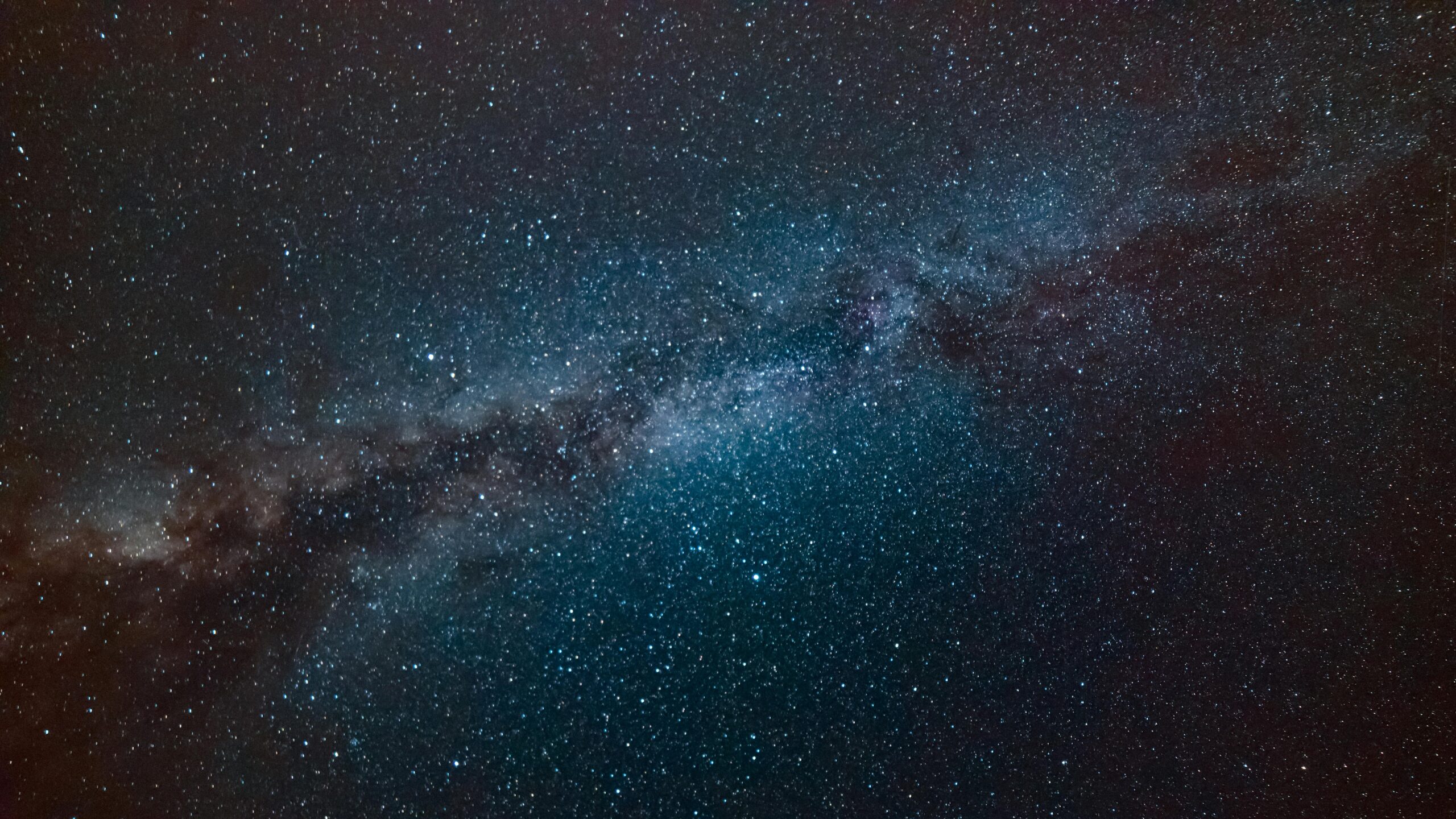
On nights like this, black and cold, the Milky Way palpable, the stars spangling jewels, and the darkness so deep, so compelling it threatens to snatch him off his feet—he comes close to believing God just might grant his request.
Simon sips hot coffee from his mug. In the frigid air, low humidity prevents moisture from coating his telescope’s lens. He collimates his eight-inch reflector into the void of Orion: the Hunter’s bossed belt, a sash cinched around stellar fascia, the bow drawn and ready. Just below the belt, a puff of angel hair: the Orion Nebula. His fingers tune the controls, focusing, centering the nebula in the crosshairs. He exchanges eyepieces, increasing magnification, but the resolution fades. At highest power, the nebula becomes a flickering swirl of cotton. He hones in on the center, a protostar: gases, mostly hydrogen, centripetally trapped, heating up over time. With a camera mounted onto the eyepiece, he snaps pictures until dawn. Like always, the solar explosion surprises him. He has been stargazing all night.
His employees say nothing about his appearance: he owns the store, he makes the rules. They ignore the bristles crosshatching his cheeks, the pouches under his eyes. Even at home, he rarely sleeps—fearful that death might catch him unprepared—instead catnapping at work until fatigue runs him over, his snores blending with the piston thrumming Pfaffs and overlocks, the hissing steam press. Three lifelong employees, huddling like mice, crowd the small room, the walls bulging with overflowing boxes: claps, hooks, snap fasteners, bugle beads, cutting knives, mats, threaders, and loopers. Four mannequins in various stages of exposure bob about the store like kinky de Sade sex toys. Ninety-year-old bars protect the opaque webbed windows. The employees know to leave him alone: his head snoozing on his desk, feet on the coffee-stained Stanley Steemer carpet, the room scented with the tannic smell of his father.
Simon wishes his father were still alive. He would have liked astronomy. A self-made immigrant, Harold Weinberg learned English by reading billboards with a Polish-American dictionary tucked into his hip pocket. Homonyms troubled his father: ware for wear, pens for pins. Mistakes most notable in the sail (sale) signs covering the plate-glass windows in the haberdashery storefront.
The elder Weinberg believed in spirits, dybbuks, and angels. He studied the Kabbala, trusting in the ordained destiny of men and women. Simon was sure he would have embraced astronomy as a way to explore the universe where his God resided.
“Simon, the sky is the seat of His throne. And why do you think the sky turns violet? It is the color of majesty.”
“But it’s blue.”
“An optical illusion. When the sun sets, see what color the sky truly is. Only a glimmer is needed for guidance.”
Simon’s father understood how the molecules in the air scattered the sunlight, but he never made science Torah, allowing room for wonder, for coincidences not explained with hypotheses, methods, or conclusions, for laws that were mutable not engraved in stone.
His father spent hours studying the intricacies of General Relativity. Runic scribbles covered a basement blackboard, and if Simon changed a single coefficient, his father would catch the error and then lecture him on curved finite universes, timeless space travel, molecules enlarging while approaching light-speed. But finally, in frustration one morning, Harold tore up his textbook: advanced calculus had claimed another victim.
Simon watched his father walk with the local Rabbi, smoke brooding from the teacher’s pipe, their voices passionate, hands gesticulating, discussing theodicy—the Penitential Psalms, Job, Lamentations. When his father returned, his face would be perilously close to impassivity, his voice uncharacteristically mute, as if to speak would open a Pandora’s Box.
“He has not convinced me. G– did not foresee the Shoah,” his father said. “If G– knew and did nothing, that makes him an accessory. Does my thinking surprise you?”
“So you doubt.”
“All believers doubt. Doubt is faith’s whetstone. Without doubt, one cannot hone the fine edge which separates true worship from convenience.” He did not demand that Simon believe in God but left his son to work out things for himself.
Simon’s rebellion ran its course: Marxism, a six-month flirtation with a Mormon book clerk, expounding the writings of Russell at coffee-shop sit-ins, existentialism, militarism. During his collegiate studies, Simon had no contact with his father, becoming the black sheep cast unto the world, discovering the two-edged pleasure of licentiousness at night, wretchedness in the a.m., until his father’s illness.
His father lay on a hospital bed, his face ashen, vitality draining from his cheeks. Only his jaundiced eyes indicated life, tracking Simon to a chair at his side. His bed was shrouded in sheets. A long catheter snaked between his father’s legs into a bedpan. An intravenous tube hung above him, uncoiling down and taped into the backside of his hand. Where the needle entered, the skin was a purplish bruise. The pungent odor of urine dominated. The IV machine beeped on and off, controlling the painkillers. An overbearing nurse jerked the blinds open, creating calico stripes on the wall.
Simon had not seen his father in three years. Battle lines crisscrossed the sides of his father’s mouth and eyes. Below the nose, a ridge of spittle, the lips dry and split. His eyebrows had become gray and bushy. Hair mingled with the death sweat on his forehead, making his bangs long and pointy like the teeth of a comb.
The sheets went up and down, but the eyes stayed alert, the mouth tight, pensive, the mind waiting for a freedom only death could bring. Now and then his father swallowed, which impressed the nurses, who thought the paralysis should have been complete and let him sip from a straw.
Simon stroked his father’s forehead with a wet compress and ran his fingers through the locks of hair. Deep within his father’s throat a rusted door creaked, the gears of his vocal cords loosening. Simon felt a susurrus of air and lowered his ear to his father’s mouth.
“Firstborn.”
At least that’s what Simon thought he’d said. But was his father referring to him, his only son?
As a child, Simon attended temple. He memorized the stories: Abraham and Isaac, David and Saul and Jonathan. Under biblical law, the firstborn male received the family inheritance, the bank savings, property, the family business. In acquiring the family name, the son was expected to assure his father’s immortality through propagation.
But Simon had failed to fulfill his duty. He remembered one of the few times his father’s face had flashed with anger: when Simon declared he planned to remain single. Because his father had no brothers, the family name rested with Simon. “If you fail to father a son, then we as a house are finished,” his father had said.
“How can anyone bring up a child in a world like ours?”
“Then get out. Don’t speak to me again.” The dismissal, coming on the day Simon left for college, pained him but did not change his resolve. He borrowed and pinched his way through school and tore up the old man’s guilt-ridden checks.
Now Simon backed away, the “Firstborn” echoing. That was the curse of words. Once spoken, they took on life, energy became mass, E=MC2, lodging within his soul.
“I will have a son. I promise,” he whispered, surprising himself with his candor, spoken to comfort his father.
A shudder crossed his father’s countenance. The ends of his lips curled. Was his father attempting to smile or was he suffering another stroke? Simon considered buzzing the nurses, but the spasm passed, his father’s body relaxed, the face softened, and tears crested around the sides of his eyes as he closed them.
Firstborn. The only word they would share before his father died quietly, the finishing stroke mercifully delivered in the wee hours of morning, freeing him at last.
#
Simon’s marriage lasted twenty-three years. He and his wife charted her menstrual cycle on the bathroom wall. When his wife failed to conceive, they visited an expert who stuck him in a cold room with magazines, a plastic cup, and an order to pump and produce. His wife took shot after shot of the latest fertility drug but suffered hot flashes, sore breasts, nausea, cramping. Finally, her insides depleted, she had to disavow even the drugs. He changed from jockey to boxer shorts, cooler testicles allowing sperm to flow more freely. He took cold showers to keep his seed volatile before performing dutifully, ritualistically, in the bedroom. Two miscarriages but no child, his wife’s womb barren as a crater on the moon. Inside her he visualized a land desolate, remote, disarmingly sterile. Failing to rendezvous at night, eventually they drifted apart, bodies wandering through space until consumed by darkness. There would be no others.
#
But tonight, Simon searches the skies, boustrophedoning the heavens, his telescope aimed toward Cassiopeia, shaped like a woman’s breasts. As his death approaches, he has one final hope to secure his father’s name in history. Deep within the recesses of space, heavenly bodies race toward earth, propelled by gravity, circling the sun at such great intervals that civilizations rise and fall between their epihelions.
The journals are full of amateurs who discover exploding galaxies, black holes, pulsars, comets. In Japan three years ago, a backyard astronomer using a similar telescope discovered a comet and had it named after him. Simon hopes to do the same, calling it Weinberg’s Comet. His father would be proud.
Simon focuses the sighting scope on Cassiopeia and takes several photographs. Astral bodies move imperceptibly; only by inspecting shots on different nights can he detect their motion.
The winds howl. He pulls the windbreaker tight around his neck and blows into his earmuffs, warming his ears. A meteor shoots across the sky, its long trail of fire cutting Hydra, the Snake, in half before expiring in an aquamarine flame.
He surveys the skies: toward the south, Betelgeuse with its vermilion shades; Sirius, steely blue and resplendent, second in magnitude only to the sun; Leo, the lion; and Cancer, the crab. Wouldn’t it be fitting if he could discover in Cancer a comet, in the astrological sign for death secure his father’s immortality by writing his name among those stars?
Simon loosens the horizontal clamp and rotates the telescope, aiming the sighting scope into the carapace of the crab. His fingers snap the controls, the shutter opening and closing, imaging billions of miles instantly. After each shot, he gently rotates the knobs, declination and ascension, shifting the viewpoint, each photo overlapping the first, mapping the constellation.
After several hours, his eyelids are leaden. Stars blur. Simon unscrews the camera, dismantles his telescope, and lays it with the tripod in the lowered backseat of his car. Driving home, he sees only a few empty, well-lit city buses, parked taxis, and police cars on patrol.
Entering his house, Simon, renewed by a donut and two cups of coffee, descends into his basement. Amidst the stacks of emergency supplies—sacks of sugar and flour, vegetable cans, instant milk and tea, drums of drinking water and nonperishables now looking ridiculous in light of his cancer—Simon has placed his work station: enlarger, trimming board, plastic trays, splash-board divider, porcelain sink, and developing tank. Old-fashioned, he does his own developing, measuring out the chemicals aligned in canisters around the sink: developer, Perma Wash, potassium ferricyanide, the walls covered with black contact paper. A single red bulb hangs from the ceiling. When he turns the light on, the room, sheathed in red, creates a claustrophobic glow. The lighting reminds him of being inside a submarine.
His most recent prints—Saturn and its rings, Andromeda, the Pleiades, and Orion—hang on a clip-line over the sink. Simon pries tonight’s photos from the film cassette with a bottle opener, loads the roll onto a reel, and lowers it into the developing tank. He pours in the chemicals, then dilutes the mixture with water and sets the alarm on his watch. Emulsion always amazes Simon: how the reactants etch magically onto the film.
While he waits, Simon thinks about an event that occurred last Friday. One of his workers invited him to a Bar Mitzvah party. Simon surprised both Al and himself by attending. A festive occasion: the wine flowed freely, with ample amounts of gefilte fish, horseradish condiment, chopped chicken livers, whitefish salad, penne pasta in miniature shells, sweet noodle pudding and other mucilaginous pastries, all devoured under the tender refrains of a rare Naderman harp. Al and his wife, Eileen, did their best to make him feel at home, seating him next to a woman who also owned a clothing store.
As their son was being toasted, the Spiegels circulated an album of Robert, who ran around the table trying to retrieve it from his relatives. After much teasing, Robert gave up and returned to his seat at the head of the table.
Someone passed the album to Simon. He held it as the woman, a paternal aunt of the boy, admired the pictures. The album contained pictures of Robert cutting a birthday cake with a conical party hat; his first steps in droopy diapers; riding a tricycle; lighting Hanukkah candles; pictures of him swimming, eating, playing, praying, fighting, crying, pouting, smiling, all for posterity. Looking over the album, filled with such adoration, aunts, uncles, cousins, mother and dad, revolving around this rather ordinary child, Simon understood what his father had wanted him to experience: the joys of paternity.
#
In the lower drawer of his workstation, Simon retrieves his album. The plastic sheets contain his family: moon and sun, Orion and Cancer, Betelgeuse and Sirius, Milky Way and Andromeda, the photographs graphic, magnanimous. Simon’s wristwatch buzzes.
With tongs, he extracts from the tank tonight’s pictures and hangs them up to dry. With his magnifying glass, he studies the drying negatives, but everything appears normal. No comets, no exploding stars. However, he notices a blur in one of the exposures and raises it to eye level, only to quickly dismiss it. But the afterimage remains, haunting, etched into his mind, a lone reflection deep within the darkness and confirmed to be none other than his own.