by Mike Solo-Thomson
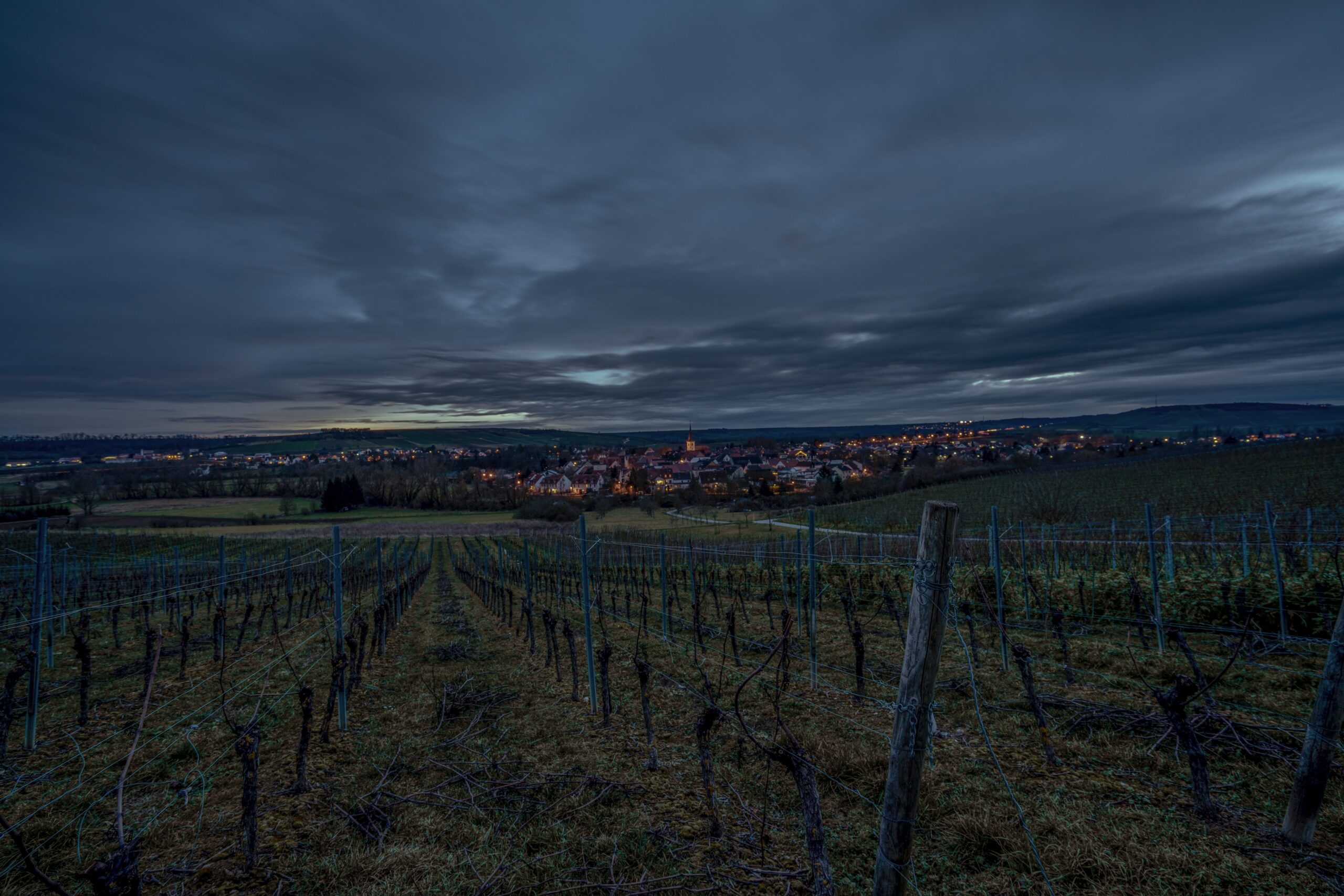
First, I had to make an offering. Instead of easing the cork out of the champagne bottle, I sent it through the air. It cleared the glass balcony and landed in the dry, crusted earth amongst the discarded grapes from today’s harvest, left to decay back into the roots of the vines.
I turned to the young Norwegian couple as they nestled into the loveseat facing the retreating sun. As I filled their champagne flutes, I said, “We start with a local Mansard champagne.”
“This is delicious.” The petite woman held her glass up to the last of the light. Her partner nodded a noncommittal echo of her enthusiasm.
“Mansard likes to blend all three grapes for their signature taste,” I added.
“Antony, is that the château from the Reddit mystery? That man who vanished a few years ago.” She reached for her phone as if to search the internet for confirmation.
“That was long ago and was centered on the next village on the other side of the ridge. A man disappeared; police were involved; there were searches in the forest. A tragic accident. No evidence that a crime was committed, but people love to create drama.” I forced a laugh and moved on before they could ask a more troublesome question.
I left the couple with the bottle and retreated between two of the guest lodges. The evening deepened as I walked beneath the two-storey cubes of wood and glass, which overlooked the vineyards sweeping down toward the river valley. I’d designed and built them myself, for my son.
A slight breeze moved the late summer heat along the rows of vines. With the vespers came a smell no sommelier would ever mention on a wine label. A mix of overripe, macerated, and fermenting fruit, the afterlife of the harvest blended with the odor of mushrooms and leaf mould from the trees above. I gazed up the slopes to the forest, like a sentinel wall preventing the village and vines from expanding into its domain. Along the treeline, I saw the shadows move as they had three years ago when the man appeared.
***
That evening, three harvests ago, he stumbled onto the path next to the forest, his gait confused and panicked.
And he was alone.
I rushed out into the vines to guide him inside the château. I draped his arm over my shoulder. No warmth remained on his skin.
“I wasn’t enough . . .,” he said, ragged with exhaustion.
“Let’s get you inside and safe,” I replied.
I was glad to see Jamie alone.
Earlier that day, Jamie Ashdown had arrived with Craig Hughes, another married couple from London in search of an authentic rural France. I’d heard them arrive when their massive black Range Rover’s V8 lumbered up the hill, echoing through the narrow streets, announcing its importance to everyone. Jamie, the taller one, had a tan, a gym-tight physique and wore expensive, quiet luxury which seemed accidental but wasn’t. The other one, Craig, swept his arms wide, trying to embrace the view, his plain T-shirt stretching across a muscular rugby build, exposing the intricate knotwork of a Celtic cross tattoo just below his sleeve. “It’s scathingly brilliant!” he said in the soft lilt of the west coast of Ireland.
“For the cost, it should be,” Jamie said.
“I’ve been wanting to come here for over a year, and now it’s like a dream.”
“I know. You’ve been reminding me incessantly. I acquiesced. We are here.”
I let the host smile settle onto my face.
“Bonjour! Bienvenue au Château des Murmures. I presume you are Messieurs Ashdown and Hughes? Je suis Antony, your host.” I exaggerated my French accent, a flourish most tourists loved.
“Oui, c’est bien nous. Nous sommes arrivés un peu en retard, nous étions chez Lauxier pour déguster du champagne,” Jamie replied in perfect French. The clean and effortless Parisian accent announced private tutors and seasons on the Riviera. He offered no apology for the lateness, only a smug lift at the word champagne. Craig simply smiled, clearly not understanding our exchange.
I continued in English. “I hope you enjoyed your time at Lauxier, and do not worry about arriving late. I have reserved the lodge closest to the forest, with the best views and the most privacy.”
“Is there a surcharge?” Jamie asked.
“All included, plus two bottles of house champagne.”
I led them down the path. Craig bounded onto the lodge’s main terrace, perched above the vines flowing toward the valley floor.
“Champagne for the sunset?” I asked.
“It would be vulgar not to. Something dry, zero dosage if possible . . .,” said Jamie as he rubbed the small of Craig’s back.
The staircase of the stately house’s wine cellar dropped into the earth, the stone steps worn with shallow hollows from centuries of footfalls. Sounds of life above slid into silence as I reached the vault, where the air sat in that liminal space between cool and cold. The smells of chalk, damp, and plaster were threaded with wisps of vintner’s yeast. Thousands of bottles lined the walls, gathering dust as they aged into life.
On the far right of the middle shelf, next to the rarest bottles, rested a small yellow toy car. I picked up the little Citroën, wiped the dust away till it gleamed, and put it in my trouser pocket.
My hand moved past ancient bottles from the very first grapes planted by the Renards at Château des Murmures. I pulled down one of the first-growth vintages, blended from vines nearest the trees and saved for those we deemed worthy. I then selected another cuvée, bright and young. The choice would also be a test.
As I approached the couple’s lodge, they were both back on the terrace, looking out over the vines.
“Imagine waking up to this every day. Look at the light and shadows. It’s an artist’s dream,” said Craig.
“It is, but I can only imagine the frost killing half your income,” replied Jamie.
I stepped forward, cleared my throat, and presented the bottles. “Bonsoir! I have retrieved some champagne to welcome you to the estate and to start the evening off in true Champenois fashion.”
Craig clapped his hands together. Jamie placed his phone on the side table and sat in a chair. Craig plopped down opposite him. Placing the bottles on the table, I oriented the labels so Craig could take photos with them framed by the vineyards stretching out below the terrace as the sun began to elongate the forest’s shadows.
“We have a choice to make: the rare 2008 Vintage Reserve, a blanc de noirs, or our famous 2018 house reserve blend,” I said.
“Is the vintage zero dosage?” Jamie asked in reply.
“We use a minimal sugar dosage. Just enough to coax the wine into life. It’s not about sweetness, but about balance.”
“Rare and vintage it is then!” said Craig.
I eased the cork out and tossed it into the vines before I poured.
“Château des . . . Murmures?” Jamie asked, reading the label. “That translates to Castle of the Whispers?”
“Yes, it’s the old name of the hill, before the vineyards were planted, and sounds grander than Château Renard.”
Craig leaned forward. “Murmures. Why was it called that?”
“It’s an old story . . . so some legend, little fact, and a lot of superstition.”
Craig was now on the edge of his seat, so I embarked on my practiced and polished tale.
“The forest above you is ancient, older than the village stone, older than any memory. The villagers call it La Forêt des Murmures, or the Forest of Whispers.
“Long ago, so long no one agrees when, the forest bore witness to a tragedy so deep, it cracked something open in the land.
“One night, two lovers ventured in. At sunrise, one came out. The other did not, lost to the rising mists of the forest. Some say there was a stinging betrayal, or simply the end of a pure love.”
I poured myself a glass of champagne without halting the story, seeing I had the pair’s full attention.
“From that day forward, the forest was different. They say it had become aware, remembering the shape of love and grief. So it looks and listens for it.”
I paused, watching them.
“It listens still.”
Craig took a long sip from his glass, looking at the trees, eyes wide. Jamie leaned back in his chair with a flat expression and left his champagne untouched. I took another sip from my glass and continued.
“We Renards believe the forest’s memories seep into the soil and breathe through the vines, and into our wines.”
“You should put that on your label. People really buy into sentimental legends about products now.” Jamie stood, stretched, and proclaimed, “I need the toilet,” and walked back into the lodge.
Craig’s gaze was fixed on the treeline. The sun was now almost set, the last of the warmth receding into the cool dusk. He tilted his head as if listening.
I wondered if he was seeing the shadows, if they were beginning to call to him.
“Is it true?” Craig asked.
“Some don’t believe, but you will find villagers will leave bottles of champagne in offering along the edge of the trees. Just be wary if you go for a walk in the evening.”
Jamie returned to the terrace, proclaiming, “Time to find dinner. Any recommendations in the village?”
“For the best cuisine imitating the terroir of the hills, take the trail right there.” I pointed to the worn path strung along the edge of the forest. “It leads to the next village over, and you will find Le Clos des Saveurs, the Garden of Flavors, highly recommended.”
“Sounds enchanting,” Craig said as he finished his glass. “Let’s go, handsome man.” He took Jamie’s outstretched hand, and together they started down the path toward the growing shadows.
***
I guided Jamie up the steps into the château, through the grand hall, and into the little salon off to the side. I eased him into a chair in the middle of a debris field of eighteenth-century antiques, all the heavy, inherited relics of the Renards who’d come before.
“I had to let him go . . .,” he said, his voice wavering. I wrapped him in an embroidered throw, its faded stag hunt barely visible.
“We saw the offerings of bottles at the edge of the forest. Craig wanted to follow the trail to find more. It was getting so dark, I wanted to hold back . . . I saw shadows . . . heard whispers . . . ‘Leave’ . . . ‘You don’t belong’ . . . Craig kept going in . . . I had to follow him.”
He plucked pine needles off his shirt.
“Craig was smiling and kept saying, ‘Can’t you see it? It’s beautiful!’ And then I saw something behind the trees, shimmering.
“He kept leading me deeper into the forest, into the shimmer . . . we were at a house, at a table, having coffee. The contour of the kitchen wasn’t right, and the colors were odd. I saw Craig content, as if he was coming into being as himself.”
I sat down in a red velvet chair, keeping my gaze on him.
“I recognized the house. Red brick, needing refurbishment, a farm in the middle of the East Midlands . . . I remember we looked at buying it. ‘Be close to your mum’s estate,’ he had said. But I couldn’t give up our life in London, to abandon everything for mud, chickens, and boredom.”
Jamie wrapped the throw around him tighter.
“He fitted there,” Jamie said. “That’s the worst part. He fitted as if he’d always been there. Like the man he’s been trying to be in that bloody flat for years. And I . . .”
He trailed off.
“I was the wrong piece,” he said finally. “I could see it. I was never going to be enough for that life. Not because I didn’t love him. Because I couldn’t be that person and still be me.
“A numbness began to creep over me. I let go of his hand . . . I let go . . .”
He sank into the chair, his face distant and veiled.
“You aren’t the first. You won’t be the last. The forest shows what we want to see. Craig saw paradise; you saw only regret.” I erased my accent, settling into my mother’s native English pattern.
I pulled over another chair. Jamie’s eyes were now more focused as I took the yellow Citroën out of my pocket. It shone like a beacon in the lamplight.
“My son, Bastien, adored the forest and was always talking to the trees as if they were friends. I let him go further than I should have. I refused to believe the stories, never thought it would take a seven-year-old child in the heat and sun of the day, but the forest swept him away, his spirit joining the others. We looked for him for days, then weeks, even years. I still look.”
My voice held firm, despite my throat closing in remembered grief. “I will stay as long as he lingers.”
“Will Craig linger . . . Should I?” Jamie finally replied.
I went to the cellarette and removed an ancient bottle. “This vintage comes from the first grapes the Renards planted. They will make you forget what happened by the morning. The choice is yours.” I poured the effervescent golden liquid into a crystal tumbler, letting the dim light cascade off the cut-glass patterns, like searchlights in the darkness. I remembered Cecile, my wife, used the same glass to forget Bastien, and then faded off to the west.
I replaced the bottle in its special place and walked out of the room, leaving Jamie to decide. I went to the phone to call the Gendarmerie.
***
A laugh drifted from the lodge stairs, pulling me away from the forest and my memories. I saw the Norwegians step onto the path. “If you’re looking for a restaurant tonight, I can recommend Le Clos des Saveurs, the Garden of Flavors, in the next village. Stay on the path.”
They answered in thanks as I walked back to the château to collect some sweet biscuits and a bottle of champagne. My hands now full, I returned to the edge of the forest. A small shadow came forward.
“I’ve brought your favorites, Bastien. Don’t eat them all at once.”
Behind him, a stockier shadow followed, moving with familiar energy. I noticed the arm had a dark, knotted pattern: a tattoo.
I placed the champagne and biscuits on the ground in front of him, along with the yellow Citroën from my pocket.
“Take care of him,” I said.
In the morning, I’ll check the shelf. If the little toy is there, the bargain still holds.