by DJ Cooper
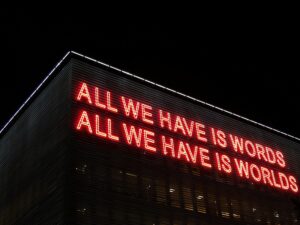
Moving into a new year is a natural time to think about goals. What we want to accomplish, improve, or simply attempt. Last year, I set an ambitious writing goal. It was to write one million words, and it sounded outrageous. But it wasn’t just about the number. It was a test. Pushing myself beyond the self-imposed limits of prior years.
In 2024, my writing came to a dead stop, and I knew something had to change. It wasn’t about my word count, but my habits. Things like screen time pulling me off into the abyss of the next funny cat video, multiple ventures vying for my time, and the never-ending notifications. My brain doesn’t always organize things neatly, and focus can be a significant challenge amidst the chaos. These distractions were killing my efforts.
In October of that year, I wrote nothing, no words . . . zip . . . nada. I sat there staring at the giant goose egg of word counts and thought, Self, this won’t cut it. Get your act together.
I knew I was right. At first, I started small. I simply wrote every day. It didn’t matter what I wrote, but simply that I wrote. Whether it was 1000 words,100, or 10, I needed to get them on the page. Then something happened. Words. Words happened. Lots of them. Nearly 95,000 words in under sixty days, as a matter of fact.
But let me back up.
I’ve been tracking annual word counts since 2023. At that time, I set a goal to write 300,000 new words in varied ongoing projects. That first year, I only wrote 250,000 words. I thought perhaps my first shot was too lofty, and for the next year I lowered it to what I knew I could hit. Two hundred and fifty thousand words were doable . . . right?
Wrong!
In fact, most of the year I didn’t write much at all, complacent in the knowledge that I could do it. By October, I had that moment of realization where all I’d actually done was to lower my expectations and then turn around and miss them. By January, I thought to myself, What if I tried something big?
One million words in 2025.
It wasn’t about the goal or even the words. It was using what the prior years had taught me and crafting a writing system to hit that goal.
I’ll be honest. The past year wasn’t smooth. In July, my mother passed away. The months after her death brought grief and responsibilities that required me to be halfway across the country. This meant multiple trips out of town where I didn’t write at all. But something unexpected happened when I finally had space to breathe. Writing became the thing that grounded me. Getting words on the page wasn’t pressure; it was relief.
By mid-December, I’d hit my million-word goal, and many questions came from my fellow writers. How did I do it? Did I just write every single day? What did I write?
Everything . . . romance, apocalypse, a psychological thriller I still don’t know what to do with. And now I have nine books hanging around waiting for their time.
I am not new to writing, deadlines, or the stresses of producing multiple books each year. My first book was published in 2014, and over the years I’ve learned how to navigate the industry and now write full time. But it didn’t happen in a vacuum. I stole moments to write wherever I could. As a charter bus driver, I had lots of downtime while my passengers were doing their things at events or outings. So, while I waited, I propped the laptop on the steering wheel and crammed in some words.
It’s about evolution for me and pushing myself to become better. That drive led me to the Online MFA program at Southern New Hampshire University. I did not choose the degree to write a book. I chose it because I saw teaching as a way to give back to the writing community by sharing all I’d learned along the way.
So . . . How did I write so many words?
I sprint-write. For anyone who doesn’t know what that is, it means carving out some time and getting all the words done that you can, taking a break, and doing it again. I spend twenty minutes writing, take a five-minute break, then repeat for as long as I feel like it. I silence my phone while doing this. Distraction is the sprint’s worst enemy.
I recommend a small notebook (I have sticky notes on a wall) for all the ideas. A million words in a year is just about a book a month. I know when I sit down to write what that day’s direction will be. I plot before writing a book, mapping the story arc with simple sentences for each chapter. My characters still get unruly and misbehave, but at least they’re somewhat on the path I set for them. I keep it all in a three-ring binder where each of my worlds resides. The binder has character sheets, because losing a character for ten chapters is never a good thing (true story). It holds the outline, timelines, and other things needed for a book or series. I keep it on paper so that I can avoid looking at online resources, which would interrupt the flow of writing and break my momentum.
There’s a lot of debate in creative spaces about the “right” way to work. Some insist that we must write every day, never edit as we go, and never measure productivity. I break most of those rules. Actually, I break them all. Regularly.
Many of the words are my thesis novel that’s morphed into an 83-year-long multi-generational saga, an entire universe that makes up the backstory of a shared world I call “The Age of Fire & Ash.”
Because I work on multiple projects at once, rereading helps me reenter the work. Yes, I edit as I go. What I learned is that systems don’t have to be universal to be effective. They just have to work for me. While a million new words is a task, I segment my time. Believe it or not, a million words in a year is only around 2750 words a day. For me, that is just under a chapter length, leaving plenty of time for edits outside my writing block.
The heart of what I want to share with everyone is simple:
There is no single “right” way to work. Some people thrive on daily routines. Others do better with weekly or monthly targets. The key is finding what works for you—not what looks good on paper or matches someone else’s process. There are tools for tracking everything—words, time, story beats, and more. Tracking tools help make progress visible and turn abstract effort into something concrete. I am happy to share one so simple as a spreadsheet.
My mantra is, if it ain’t broke, don’t fix it.
Even if you hate every word you write, the most important thing is that you write them.
I want more than anything to encourage writers to set goals of their own. Big ones. Small ones. Messy ones. And then give yourself permission to miss them, start over, and forgive those less-than-perfect spots in your manuscript—that’s what revision is for.
Goals are not contracts. They are direction and motivation.
If you don’t hit them, that doesn’t mean you failed. It means you tried. Goal-setting gives direction. Without it, it’s easy to drift or feel stuck. With it, even imperfect effort has purpose and progress. And self-condemnation has never helped anyone grow.
All of which is to say: It isn’t the number. I’m going to repeat it a little louder. It’s the act of setting a goal, tracking progress, and continuing forward even when things don’t go as planned.
So go ahead—set the goal. Chase it imperfectly. And when you stumble, don’t stop—just keep writing your way forward.
Will I write another million words this year? I did consider pushing the bar higher, but I have edits and other writer work to do, so for now a million works for me.
What works for you?
Category: