by Elizabeth Wischler
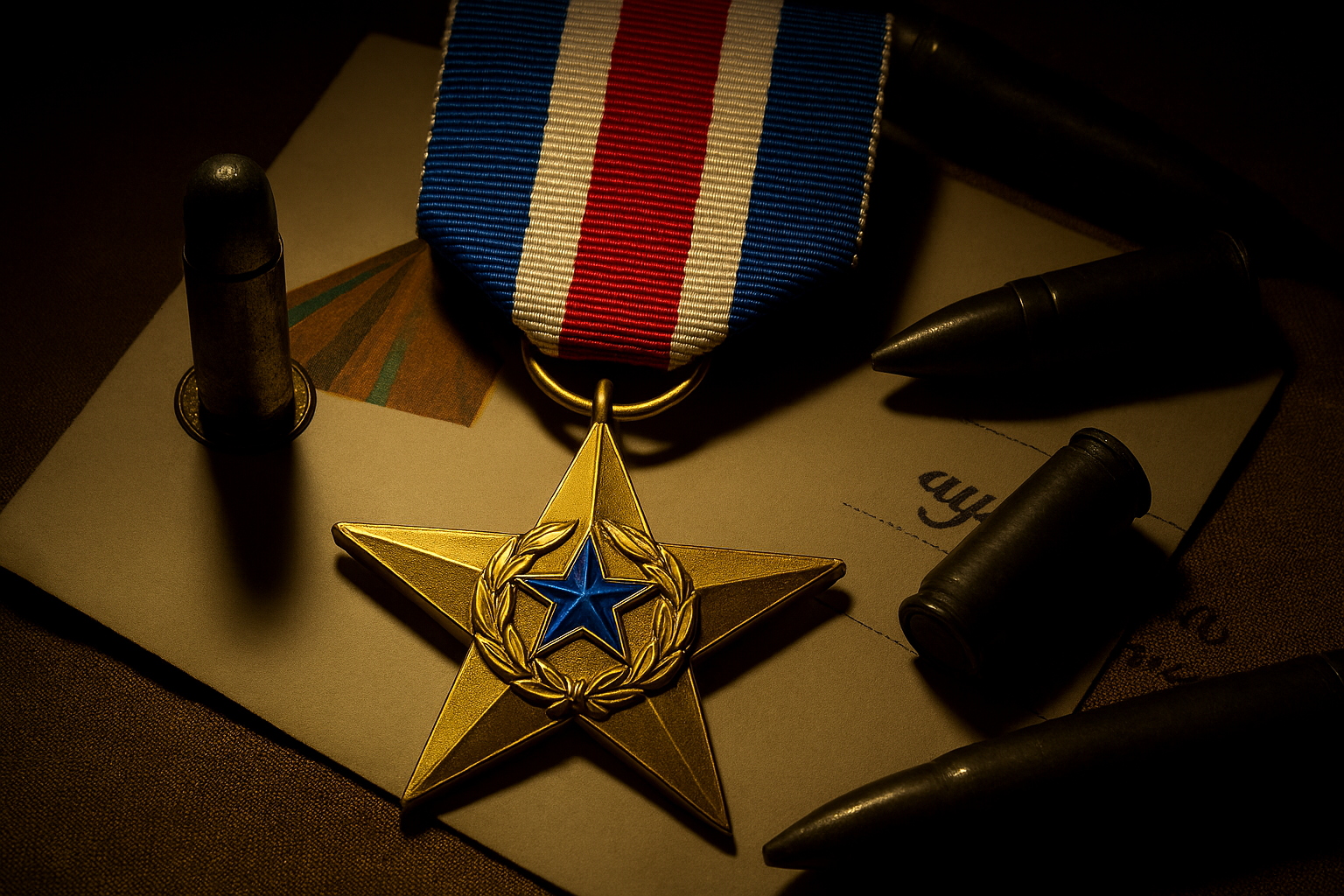
Thomas Ray hadn’t touched the box since it arrived. It lived under his bed, where dust settled without judgment. He didn’t talk about the war, not in church, not over coffee. Not when his wife asked why he woke up gasping. The medal came three years late. “Your Silver Star for actions near the Falaise pocket,” the letter said. Typed. Detached. Recognition wrapped in a velvet lie. When the box first arrived, Thomas didn’t open it. He placed it under the bed like a buried confession. Velvet shouldn’t cover Silver. Velvet was too soft for what it meant. Some nights, he lay awake with the box pressing up through the mattress like a memory trying to surface.
~*~
August 1944. The air over Chambois was thick with burning meat and diesel. German vehicles twisted into mangled fences. Cattle lying bloated in ditches. Artillery shook the fields until the soil clotted into something unholy. Thomas stepped over bodies like roots. His boots sank in slick patches of mud and blood. Smoke clawed the sky.
Corporal James Keene had joked two hours earlier about learning French. He’d been flipping through a phrase book, laughing at the word for “truck.” His boots had come loose, soles flapping with every step. He’d laughed about replacing them “after the next damned hill” just hours before. Now he lay trapped under a halftrack, legs shredded, oil leaking into his skin. The boots lay beside the twisted metal, one toe pointing north, as if still trying to march.
Keene had once stitched his name into the collar of his uniform with neat, straight block letters. “So they’ll know who to cuss out if I screw up,” he’d said and grinned. He shared cigarettes and bad jokes, talked about his brother back in Omaha, who thought war was noble. Thomas figured he was just scared like the rest of them, but he smiled anyway.
“Don’t let me burn,” Keene begged, arms trembling. “Please, Ray. Don’t let—”
Thomas aimed his rifle.
“You know what I need,” Keene rasped. “Please.”
His fingers curled, paralyzed, couldn’t pull the trigger. He dropped the rifle and ran toward the burning wreck. He dragged Keene out, through smoke and slush and something that smelled like vomit and gunpowder, to the aid station. He didn’t think. Didn’t feel. The bullet that clipped Thomas’s shoulder felt softer than the weight of Keene’s screams.
Keene died in the aid station. Not in glory. In a morphine fog, begging for his father. Thomas never went back to the aid tent. They gave Thomas a medal. It shone brighter than it should’ve, the moment he froze, the blood he didn’t stop, the man he didn’t save.
~*~
Detroit 1952. Thomas fixed cars but couldn’t fix himself. A neighbor’s car backfiring sent him scrambling for cover. He laughed it off but slept in the basement that night. His wife once asked why he didn’t wear the medal. “It doesn’t match anything,” he muttered.
One Fourth of July, he sat alone on the porch while neighbors lit fireworks. The first pop shattered a beer bottle in his hand. Only the sting of glass shards told him how tightly he’d gripped it. The sound of the bottle shattering wasn’t the loudest thing in his mind. It was the echo, a dry crack like distant gunfire, followed by silence. Feeling the beer seep into his jeans, sticky and cold, he remembered mud. He swept up the glass without speaking.
The box stayed buried.
One afternoon, his son, Jimmy, found it under the mattress. “Cool,” he said. “Did you save someone?”
Thomas stared at the small silver star in its velvet case. It glinted in the lamplight like the rifle barrel he couldn’t bring himself to fire, the silence that followed Keene’s last breath.
“I tried.” Moving his shoulder instinctively as he spoke. That movement was automatic now. His body remembered even when he didn’t want to. His shoulder ached some mornings, phantom pain from a wound not stitched properly, or perhaps the memory pushing back. Pain wasn’t the worst part. It was a memory of the exact sound of Keene’s voice.
Jimmy placed it next to a photo of Thomas’s unit. Twelve faces, ten still alive. That night, Thomas sat on the edge of his bed and held the medal. The same blue as the sky over Saint-Lambert when the screaming stopped and silence took its place. It was cold in his hand, like the steel of his rifle after he dropped it. He placed it on the windowsill, not out of pride, not out of forgiveness— just acknowledgment.
The medal gleamed briefly, catching the late sun, five inches of silence, an honor for a man he couldn’t save. . Let it tarnish in the open air. Let it remember.