by Emily Brochu
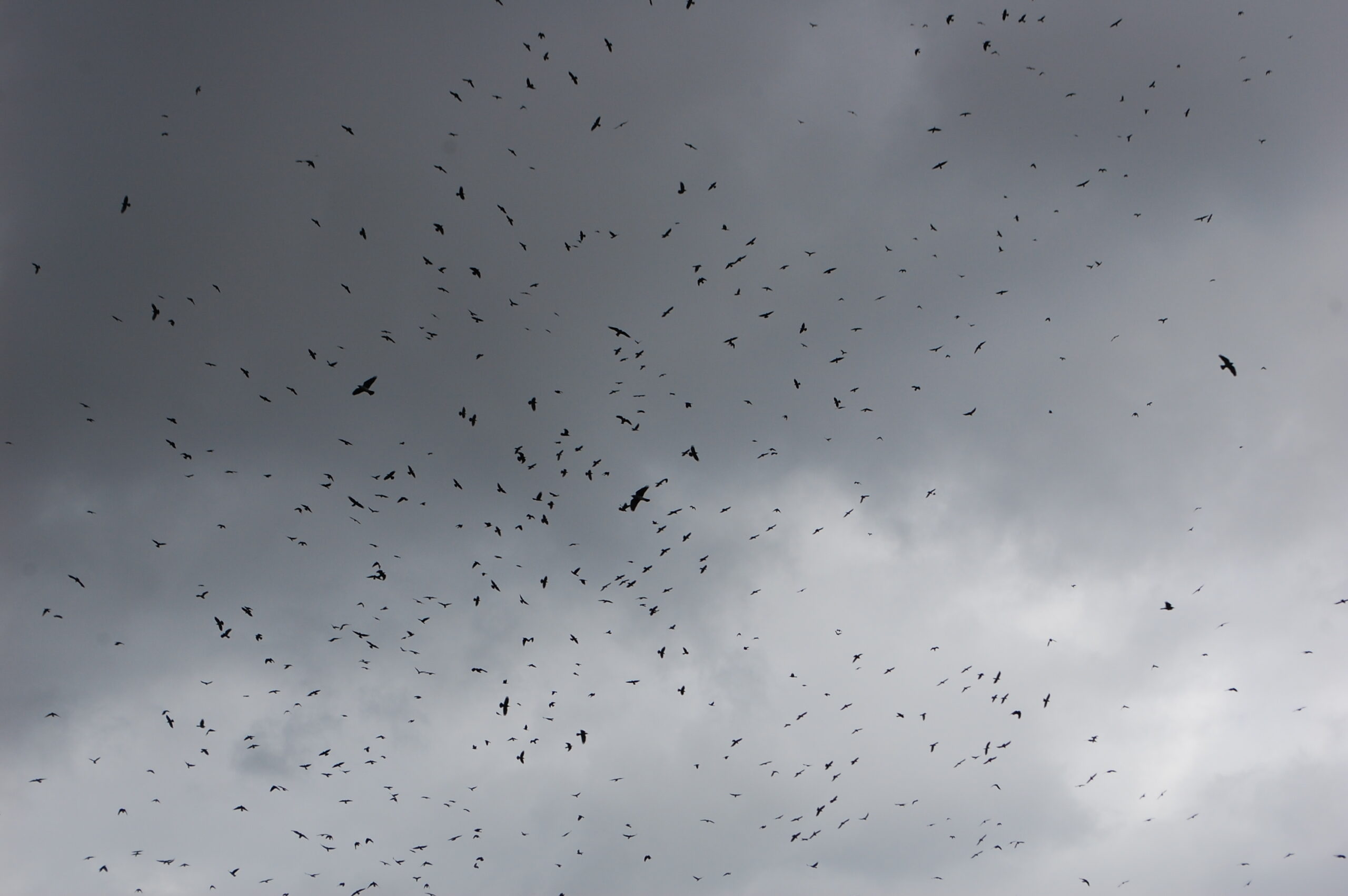
By October, the crows returned. They always did.
They came with the cold wind—black flocks swirling above the cul-de-sac like storm clouds too dark for the sky to bear. The air grew heavy when they came, thick with the scent of wet earth and smoke. They clung to the skeletal maples like knots of shadow, bent the telephone wires until they hummed, and scattered across rooftops like soot after fire. Their voices rose in a ragged chorus—harsh, unending, ancient. Windows were shut. Curtains drawn. Neighbors muttered prayers they pretended not to know anymore.
People called them pests. Bad luck. A nuisance to be driven off with clapping hands or a broom. But Eli knew better.
He was twelve, and he had been watching them for half his life—since seven, when his grandmother leaned close and whispered the truth in a voice dry as autumn leaves: “The crows don’t come for nothing, boy. They choose. And when they choose, it’s already too late.”
She had told him the old stories, the ones people forgot because they wanted to sleep through the nights. In Norse lands, crows were Odin’s watchers—Huginn and Muninn—memory and thought, bearing secrets between the living and the dead. In Celtic tales, the Morrígan flew above battlefields, her feathers slick with the blood of men she had named. But in the stories whispered here, in cracked kitchens and back porches and graveyard corners, crows were not gods’ messengers. They were omens. They did not only watch. They marked.
The year they filled Mrs. Patterson’s oak, she never woke from her sleep. The year they lined the red brick fence, Mr. Klein clutched his chest and fell where the crows had gathered. And the year they covered the McAllisters’ chimney, fire took the house before dawn.
By ten, Eli had stopped doubting. Every fall, the crows claimed a house. And before the last leaf fell, someone inside was lost.
The adults refused to see it. Maybe they couldn’t. His mother laughed it off—told him to stop watching horror movies, to stop scaring his sister. But Eli wasn’t inventing monsters. The monsters were already here, black-feathered and patient. He had the proof of five black autumns pressed into his mind like fingerprints in wet paint.
This year, as pumpkins sagged and the wind sharpened like glass, the crows came early.
He noticed first the silence before them—the sudden hush that fell over Maple Street one gray morning. No wind. No dogs barking. Even the air seemed to hold its breath. Then came the flutter, the sound like distant thunder made of wings.
Eli stepped onto his porch, and his stomach turned to ice.
Across the street.
The white two-story.
Jonah’s house.
His best friend’s house.
The roof was crowded with black judges, wings restless, heads tilting in unison. The sky above seemed to darken as more arrived, their feathers gleaming like oil slicks in the weak sun.
Jonah came out with a football in his arms, his breath a pale ghost in the cold. He grinned. “Hey! Wanna throw?”
Eli’s eyes flicked upward. The crows were still. Watching. Always watching.
He swallowed and nodded.
They tossed the ball in the yard, but Eli’s hands felt wrong—clumsy, heavy, cold. He kept counting them. Twenty-three. No—twenty-four now. Another landed on the chimney, its beak open in a silent scream.
“Dude, you okay?” Jonah asked when Eli missed again.
“Yeah,” Eli muttered, clutching the ball like a heartbeat. “It’s just—don’t you think it’s weird?”
“What?”
“The crows. On your house.”
Jonah squinted up. “They’ll fly off. They always do.”
“No,” Eli said, too quickly, too sharp. “They don’t.”
Jonah frowned. “Then what?”
Eli opened his mouth, then shut it again. How do you tell your best friend that death has already perched above his roof? That the sky itself has chosen him?
“Never mind,” Eli said finally, throwing the ball too hard. Jonah laughed, not seeing how Eli’s hands shook.
That night, Jonah’s room was warm with the smell of dust and blanket forts, the soft blue light of a dying game screen flickering across their faces. Jonah slept easily. Eli did not.
Outside, the crows whispered.
He heard them shift across the roof, claws clicking like beads on a rosary, feathers brushing against the glass. Sometimes one would give a call so low and guttural it seemed to crawl down the chimney, slithering into the dark.
His grandmother’s words came back to him like a curse he’d never stopped hearing: “If a crow calls thrice outside your window, the soul it’s come for has already crossed the threshold.”
Eli buried his face in his pillow. “Not him,” he whispered. “Please, not him.”
The crows rustled, and one gave a long, dragging cry that scraped his bones raw.
By morning, Jonah was sick. His skin was pale, his eyes glassy. His mother said it was the flu, but her voice cracked on the word. They took him to the hospital “just in case.” Jonah smiled, weak but certain. “See you later,” he said.
The crows watched from the telephone wires as the car pulled away. One called—once, twice—then fell silent.
Three days later, Jonah was gone. A sudden infection, the doctors said. Too fast. Nothing anyone could do.
The day of the funeral, not a single crow remained on Maple Street. The sky was too clear, too blue, like it had been scrubbed clean. The air felt empty in a way that hurt.
From his window, Eli watched the stillness settle over Jonah’s house. The curtains were drawn. The toys on the porch untouched.
Then, as the sun dipped behind the trees, he saw it—a single black feather spiraling down through the golden air, slow and deliberate. It landed on the front walk, dark against the dying leaves.
Eli shivered.
The crows would come again. They always did.
And somewhere on Maple Street, the crows had already marked what the living had not yet learned to fear.