by Ryland Louvierre
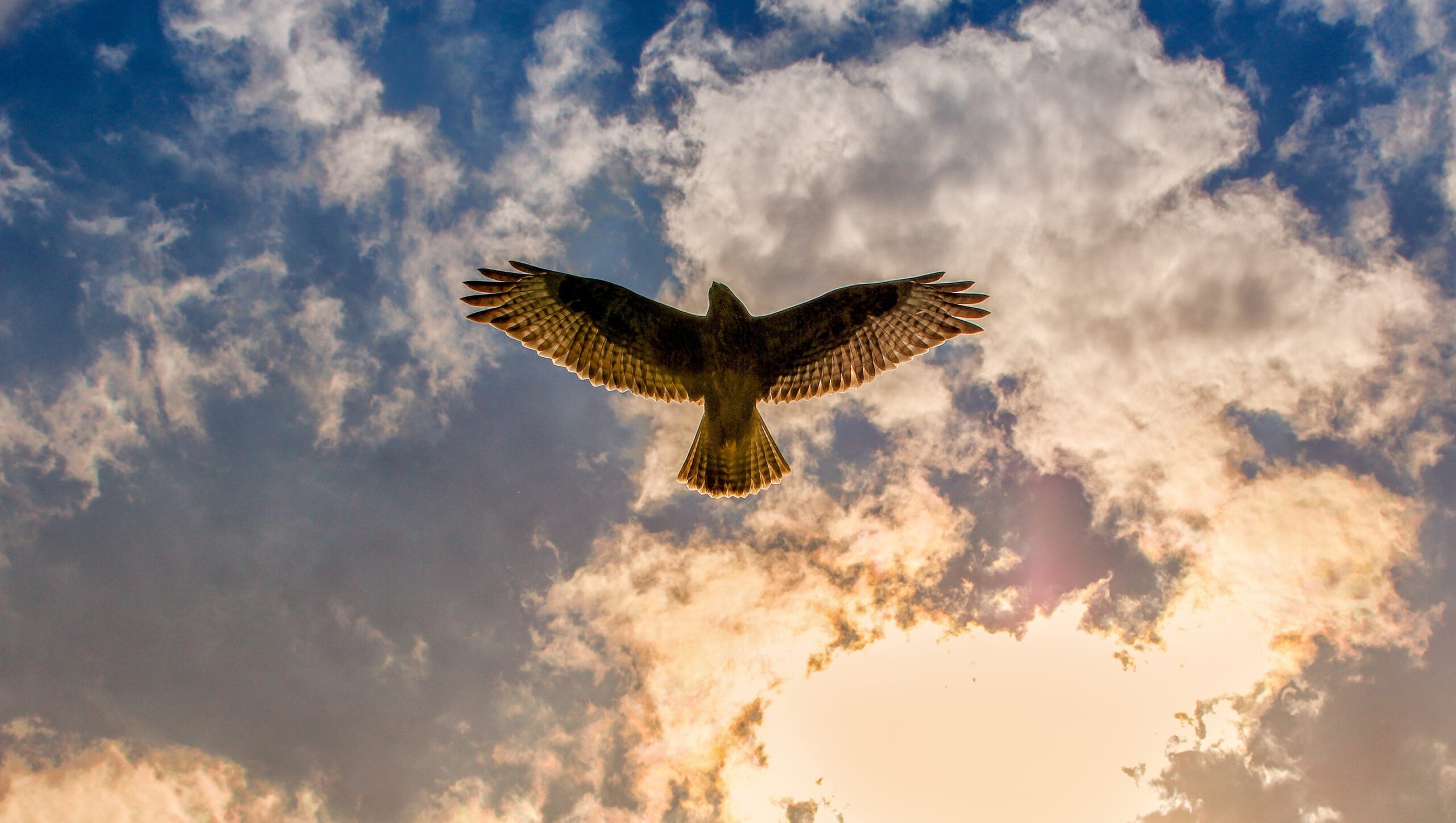
It was six o’clock on an unseasonably warm Saturday evening in February. The birds had gone to their nests, replaced by bats that swooped low in the wood meadow, and Cleve rose stiffly from his position in the pecan tree. A grapefruit sun was setting, casting oblong bars of blood-orange, blood-yellow, and blood-purple-red, drenching the musky oaks and pines and dogwood trees in blood-honey. Cleve hopped down from the pecan tree; his young and limber ankles not buckling as his sneakers thudded to the thick centipede grass below. He hitched his dirty jeans up and slipped the bird book into his back pocket. It had been a good day for bird-watching. In that meadow alone, he had identified over a dozen different birds with his book; cardinals and jays and robins and finches, and even spotted a crane flying over, heading to the nearby Pee Dee River. Cleve didn’t see the buzzards until he headed home.
A well-worn path led through the shaded understory of hardwoods—pecans, hickory and red maple. The knee-high grassy carpet was haphazardly calloused with gray-honeyed knolls, and patches of red clay pocked the small hills like bursting pimples. The path led past the family cemetery, a series of unkept mounds that rose from the soil, with tombstones poking up and out like crooked teeth. Cleve didn’t know anyone buried there but paused long enough to regard the faded names and dates of deceased ancestors. The largest tombstone bore the name Larry Baxton, who was born in 1853 and died in 1900. There was a Janine Baxton born in 1902 and died in 1980-something; the last number was faded. There was a smaller headstone, this one a chiseled piece of slate with simply the dates 1945-46. No name. He wondered briefly if any of them were bird-watchers. Then he walked by and turned left where another path ushered away from the woods and toward the fenced pasture where his granddaddy’s cows and goats grazed. It was a longer walk home this way, with jagged stones protruding from the earth, making the walk tough on one’s heels, but Cleve enjoyed the scenery and hadn’t been by the pasture in months. He stepped carefully over the stones until, where a portion of the fence bowed inward, the ground leveled out. This was where his granddaddy would haul in hay or feed with his truck. Cleve scanned the grazed field, the grass shadowed by the looming trees in the distance, looking for a fat heifer to moo at, and that was when he first noticed the giant birds circling the eastern corner of the fence.
They were turkey vultures, Cleve knew. Scavenger birds that feed on carrion. But he had always heard them called buzzards. He didn’t know much about them, which was what prompted him to pull his bird book out of his back pocket. He found the entry and skimmed the details regarding the vultures, then slipped the book back into his pocket. Cleve figured they had found a dead deer or possum, but then he noticed a circle of them on the ground, hopping and frolicking around in their ritualized feeding, and thought there were too many for it to be a dead deer. It had to be something bigger. One of granddaddy’s cows, perhaps. Cleve recalled a time when his granddaddy had put down a mad cow that had an abnormal posture; it had lost so much weight in the weeks prior that its udders appeared disproportionately larger than its body, and when his granddaddy had showed him how to humanely kill a diseased cow (“A shotgun to the beast’s skull,” Granddaddy had said), Cleve couldn’t close his eyes fast enough. All that brain matter and blood still haunted him.
He shuddered the memory away and kept walking.
The smell hit him as he walked along the fence. It was a smell he was familiar with (growing up in the country, Cleve was used to the smell of dead animals lying in the road or on the shoulders of the backwoods blacktops), but there was something different about the putrescent odor he smelled now. It was faintly sweet, as if whatever species of carrion it was, it had been dipped in powdered sugar, bringing to Cleve’s mind an intestinal funnel cake.
As he got closer and could make out the square-tipped tails and red-faced features his bird book had described, he heard their hissing. There were four hopping around in a circle, wings spread partly open, mewling and hissing and grunting at one another. Six or seven soared above them, in pairs, flapping and diving in wide circles. They hadn’t noticed Cleve’s approach yet, and he paused along the fence, kneeling into the grass. It irked him that he hadn’t brought his binoculars. In his impulsive decision to watch birds after supper, he had left them in his sock drawer. He didn’t want to disturb the buzzards by getting too close, but he was also curious as to what they were dining on tonight.
Putting a hand on the fence wire, and thanking God the wire wasn’t electric, Cleve used his knees to shuffle closer. A vein in his neck began to thrum then, a taut banjo string being pulled from a hand across the universe. Wind lapped at the sweat on his neck, and he shivered. He looked around and realized there wasn’t any wind; it was fear he was feeling. He reached one vertical post, sidling along with the horizontal wires, and shuffled to the next section of fence. The ground here was uncovered, cold, revealing large clumps of white and red clay.
He scooted past the clay, and a small twig beneath his left knee snapped.
The group of buzzards circling on the ground like deranged children in worship of a woodland deity hobbled away in meandering directions and took flight. Cleve shook his head disappointedly and stood up, dusting off the knees of his jeans. Uncaring to be quiet now, he ambled over the protuberant limestones to where the buzzards had been and felt his calves rear back like those of a stallion rearing before a cliffside at what he saw lying there in the gray-green grass. That fearful wind he’d felt before wasn’t lapping at his neck anymore but damn near tickling his esophagus now. He had to cover his mouth and nose, not only to protect his senses from the sweet-rot smell but to keep from vomiting his supper of cube steak, mashed taters, and green beans into the gore.
What the carrion feeders had been eating wasn’t a deer, a goat, or even a cow. Cleve saw clearly in the blood-wash light of the sun’s carcass that it was a human corpse lying naked in the bed of grass, half-eaten, with mangled limbs and a tangled web of bloody black hair covering its face. The man’s stomach (he could see from the shriveled and limp penis that it was indeed a man) had been bitten into, the entrails pulled out, leaving a hollowness beneath the starved ribs, and spooled onto the ground beside the body like links of spoiled boudin. The sight of the viscera, stark and glistening in the dusky sunlight, brought chunks of acidic cube steak to Cleve’s mouth, which he swallowed back down in a harsh and stinging gulp.
Cleve backed away, hands to his hitching stomach. He couldn’t help but to imagine his own disembowelment and felt like it was happening now. His supper was coming up, and he knew it would have been too much to swallow back down this time. With a hand on the top wire of the fence, Cleve spun on his heels and vomited into the grass. It was chunky at first, causing him to gag. His temples throbbed. A stinging sensation in the back of his mouth, where the sinuses connected to the inner ears, rivered up into his watery eyes until he finally felt the stomach acid gushing out of his throat and onto the ground, spattering near his sneakers. It was orange and thick and mucous-coated grime.
He spat the last bit out and wiped his mouth with his bare hands, flinging away what saliva and vomit clung to his fingers, then stroked his hand down the side of his jeans. Feeling lighter in the stomach and his head, Cleve turned back around slowly.
It was easier to see the dead body the second time without queasiness. Cleve walked closer to it and knelt beside the pile of bowels. The dusky light was fading now, deepening into long and hard shadows that cascaded from the hardwoods on the other side of the grazed field. He estimated how long it would take him to run to the farmhouse (twenty minutes), get his granddaddy, and show him the dead body (another twenty minutes back, by which time the nightshade would have veiled the body) versus how long if he stuck around for a few minutes first and inspected it. He had never seen a dead person before and wanted, only for a few minutes, to have it to himself.
The hair covering the man’s face was bloody, but Cleve reached out delicately and swept a patch of it away. The man’s nose was lilac-purple, bulbous and bruised. The skin on the man’s lips was cracked, like mud dried up in a drought. Sweeping away more hair—some of it sticking to the man’s forehead like masking tape—Cleve noticed the man’s eyes were opened and frozen in a death glare. They were gray and lifeless, forever staring. He recalled in a movie (what movie it was he couldn’t have said but thought it was one of the spaghetti westerns his granddaddy liked) that people would close the eyelids of dead people, and so Cleve used his fore and middle finger in a peace gesture to close the eyes. He was unsure why people did this but thought he realized why when a sigh of relief came over him at no longer being watched by the dead. Across the man’s neck was what looked to Cleve like a purple ring, as if the man had been hung from a tree—or, Cleve suspected, having watched episodes of Forensic Files with his meemaw after Granddaddy went to bed, he was seeing ligature marks. The word garroted came to his mind then, and he was proud to have remembered it from one of those crime shows. He looked around for an item that could have caused the man’s strangulation but then realized that if the man was here, on his granddaddy’s land, he probably hadn’t been murdered here. He’d been dumped.
“Who are you?” Cleve asked listlessly.
He half expected the man to reply when he saw movement from the dead man’s legs. Terror seized him, then, realizing it was his own knee sliding in the patchy clay, he chuckled nervously. He looked over the man’s bone-white skin, from his sunken cheeks to the yellowy nails of his toes, and tried to place him. The population of Wolfeboro, North Carolina, had doubled since 2002, five years before, and there was no way of knowing who the man might’ve been. Cleve and his grandparents lived on the outskirts and rarely ever went into town unless they needed what groceries the farm couldn’t provide. But he couldn’t imagine anyone living in town with that kind of hair. It was jet-black, like the burnt oil from his granddaddy’s tractor. Nearly every white guy living in town and the surrounding towns had brown hair, including Cleve. This man was an outsider.
The sun was gone now. The field and the fenced pasture and the woods beyond were cloaked in a veil of darkness. A smiling moon juxtaposed against the glimmering belt of Orion was enough to illuminate the paths back out, so Cleve stood up and continued home.
He followed the moon-ribboned path into another wooded meadow and paused. Turning around, back toward where the body was, he saw the buzzards swooping back down to finish their supper. In the wash of moonlight, they looked like sleek ebony cannibalistic children, cleaners of the dead and night, guardians of an underworld that, until this moment, Cleve had no experience in. The buzzards hissed and grunted, flapped their wings and ate with hungry joy, pleased to be filling their cadaverous bellies, and at that moment, watching them, Cleve didn’t want to disturb their dinner by telling his granddaddy what he’d found. Cops would be called, and an investigation would ensue, and Cleve, a young boy who enjoyed walking into the woods and fishing in the river and watching the birds in the sky, wouldn’t be able to until the investigation was over—if ever again at all, knowing how protective his grandparents were.
No, Cleve decided. I’ll keep this secret to myself. The man is already dead anyways, and this is just the circle of life, yeah? People die and return to the ground, to be eaten. He turned back around and peered into the shadowy trunks of trees and silky spider webs silvered in the dainty moonlight and followed the path back home.