by Cainhurst
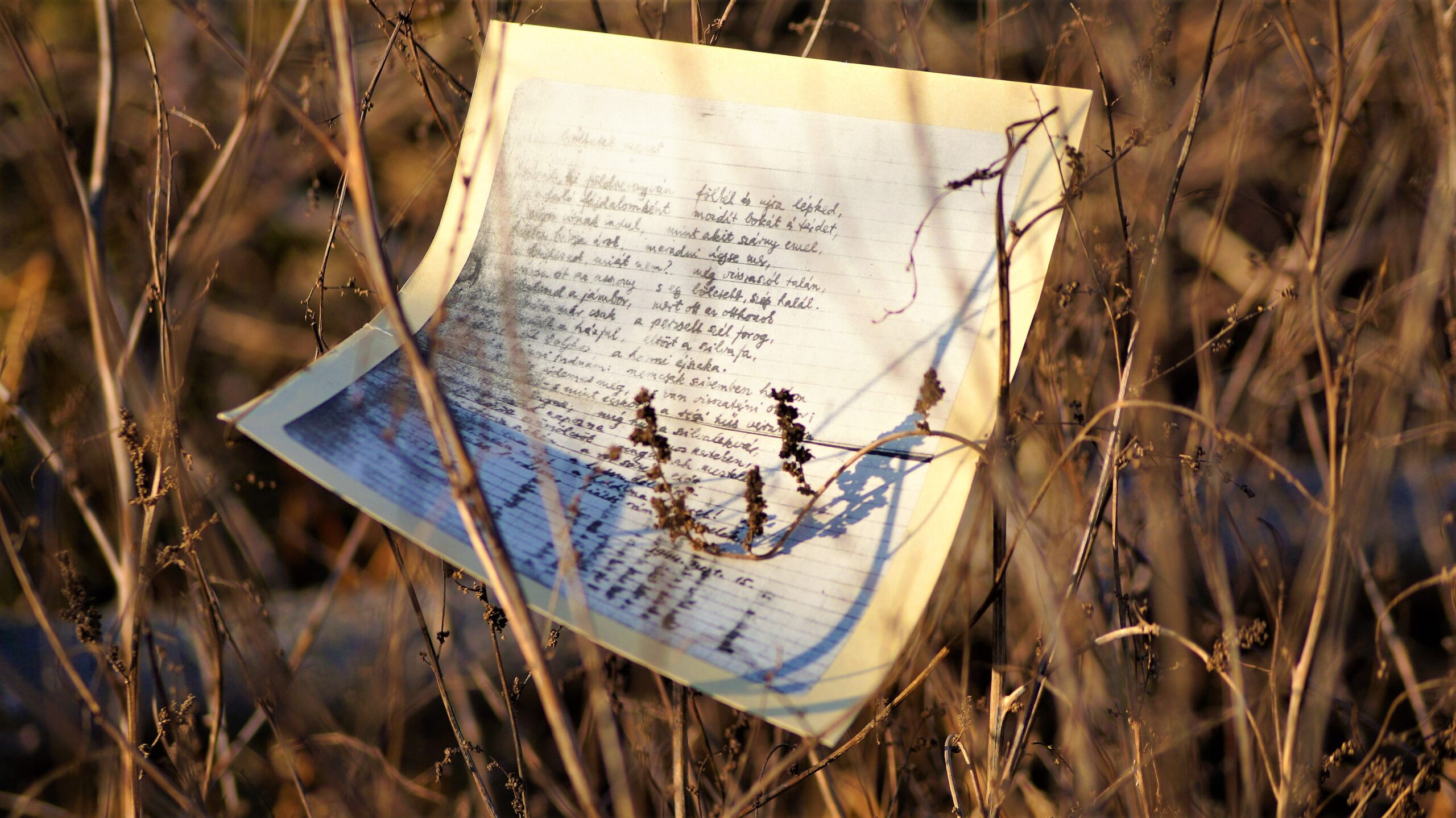
As a kid I cultivated the habit of reading the same poem every morning before going to school. The other kids remained unimpressed by the lines that fell from the burning tip of my tongue, they were only a bit dazzled by my aggressive utterance, they didn’t even know what a poem was. I started then to relish the high solitude poetry seemed to give me, and whenever I felt sad or weak or disgusted—and the occasions were as long as a typical school day—the whole class being brought back from the heavenly outskirts of the school by the late teacher, after being expelled by the principal, thinking he was too late to show up; horizonless minutes of studying the shapes of boredom; dirty toilets and a nearly exploding bladder; some kid producing a handful of boiled locusts from his pocket and inviting me generously to share in his lunch, or another one snatching my jam-and-peanut-butter sandwich; the teacher’s bad breath; his yellow ruler, halved and joined by black duct tape, or the metallic end of his compass, as sharp as when it first came from East Germany, both favorite disciplinary tools; chanting the national hymn in the hot afternoon sun—whenever I was in one of those situations—I started reciting poetry in my heart, and a dark cloak covered me, elevating me far above the common ground, far away from rules and dust and discipline.
Moreover, during the brief moments of sucking on the beads, I was not related in any way to the rest of the herd. I became a spirit made of paper and ancient ink and long-forgotten words. For the poem had been written by an old Arabian scribe who lived in the court of the high Persian King of Kings. Ordered to write a short letter inviting his tribe for a royal audience, where hidden slingers would resurface a hollow vale with a new layer of stubborn skulls, the scribe found an opportunity to display his poor poetical skills, using them to warn his tribe of the monarch’s intent to slay them all. The scroll found its way to the king, and the scribe was as faithful in translation as he was loyal to his tribe. Thus his tongue was pulled out with hot pincers, and he was tortured and then flayed meticulously, or so I remember from my early reading experience. The slingers had just to use bigger and sharper rocks, and three elephants were bothered from the royal stables to crush the hesitant bones. Still, the Sassanid Lord was not happy.
The poem sometimes broke during my reminiscences, the cloak fell, and I felt suddenly the more naked, clumsy, and vulnerable for not retaining the cryptic verses. I could not pin the cloak in my heart more than once, and only for a few seconds. If I jammed the words up, wind would break in the tattered poem, with heaps of sand and weird hissing sounds. Cheating was also out of the question. I tried once to write the poem on a slip of paper, even went as far as to tear it away from my grandfather’s poetry book and use it as a talisman, but it had to spring from the deep trenches of my soul in order to be effective.
This went on for a few months, then the trick had no longer the same effect, the poem was dried up by the frequent use, and it was not in any way related to my life when I searched for a closer connection. My familiarity also with the surrounding world and my growing curiosity did not warrant anymore such swift aesthetic escapes. In fact, I can trace everything I learned about life to the short minutes between the recess bells.
I gradually abandoned the poetic invocation and wrote real poems instead. I was reconciled with reality and expressed it in childish verses of deep religious feeling, patriotic allegiance, and parental love. From around eight years old to ten, I had assembled a small volume, I even got as far as to refuse my family’s desire to print it, my grandfather had it printed anyway and sent it to a regional poetry contest for college students, they gave me the second prize and I declined it. The happy and submissive tone of the poems irritated me as I grew a few inches taller, and I finally burned them.
Our precious, pre-disillusion years are entirely compartmentalized by the educational system, even holiday incidents are marked in our memories by their grade equivalent. In middle school, when the teen cleaves the unexpecting child like a molar an innocent gum, poetry was needed again. Although I was easy to befriend, and the world around me became slightly intriguing and comical, the fake solitude that a poem can provide made the sacrifice of those exploring times the more essential. I ventured through acres of winding verses to find a suitable cloak; it was stitched by another boy of fourteen.
To my present knowledge, Mutanabi is the most complete poet, till the bitter end that is, for one bad poem killed him. He was a convict of poetic justice and ultimately a victim of his own greatness. Leaving Egypt after a disappointing journey, where he confirmed once again the disparity between his genius and the pettiness of the world, he was tired and crestfallen from his successive attempts to find an equal conqueror in action and crossed the desert back toward his native land. A chieftain he once insulted in mediocre lines cut the lonely poet’s road with his whole clan, the poet was about to flee the certain slaughter, when the armed men cried loudly some of his verses on bravery and death, he charged back, cut some throats until he saw his own blood flowing abundantly.
Mutanabi celebrated himself with such a fierce and absolute selfishness that only Fichte would reach in his metaphysics. “The one who claims to be a prophet,” that is the meaning of his name, he rather saw himself as a new Christ. In that early poem he begins by comparing his birth and sojourn between his kinfolk to that of Jesus in Galilee. I covered myself promptly in it whenever I was in public, girdled it with a short text by Gibran: “Jesus the Crucified,” and sat idly around my lambs like the Good Shepherd of Ravenna. This frescoed accoutrement, instead of making me meek and gentle, planted in my heart deep shards of conceit and arrogance. Thus, I was baptized by the Muta-Christ in hatred. Years later, when I read Dostoevsky, I sought Jesus’s likeness in Ivan Karamazov and Stavrogin, even the ultimate failures of those dark characters felt like a writer’s hasty crucifixion.
The more I recited the poem, the less I remembered it, and although I possess a very precise memory, never being able to forget a face or a name or a lesson, reciting back then entire sermons in the manner of Fichte, the poem had to be processed over and over again in order to break some sharp rhyming ends and stab the long day. Like the features of a beloved person, the verses disappeared when I hardened my memory to retain them. Perhaps it’s hard to preserve the essential because the distance only makes the unremembered dear. Nevertheless, most of my pleasure sprang from the faint suspicion of forgetfulness. The memory, neutralized, gave way to pure fancy.
The mystic experience was short-lived, it became affected like forced masturbation. I tried various disguises during those turbulent years, but nothing was quite appropriate. I continued to read for myself. However, depraved and decadent, a teenager with an elderly heart, fewer poems each time seemed to provide me with any pleasure. The problem lies in the language, I realized. Other worlds were just waiting to be colonized. So I studied French poetry. Rimbaud naturally caught my eyes first, and I wept over his pages like a girl snatched out of the world by her over-turbaned kinsmen, as I dried up my cheeks, the alchemy of his words vanished, maybe they were more convenient to ignite older people with adolescent hearts. I never read them again. I loved Ronsard, Nerval, Laforgue, and Lautréamont, and had an instant dislike for Verlaine and Mallarmé. Valéry and Claudel were hard to follow, but I enjoyed disintricating their complicated strains.
The road to high school was the longest. I walked, clumsier than ever, stricken by the vertical rays of the sun, and each member went a different way. No day-borne poem could glue me back, so I read Baudelaire, and his spleens dripped their tepid bile of seasoned darkness over my limbs. This northern melancholy would soon become a dream, the impossibility of which I measured by the stifling heat in my native clime and the tyrannical permanence of the sun.
I pursued my poetical plundering to no avail. I learned German on the side during college, though initially interested in discovering the real Kant and the real Kleist and the real Spengler, the poetry I discovered delayed the rays of imminent disillusion that I felt coming through the lack of rhythm and melancholia. A long, eternal winter in the heart of the black forest, that’s what I longed for.
I finally found a cold poem that could be both retainable and transportable. “Ein Winterabend,” by Georg Trakl, the poem that Heidegger famously destroyed with his heavy paws. I nevertheless took a perverse delight in seeing the heart of the forest disappear in a blow of concepts, philosophy was interesting as a bonfire of beauty and only afterward as a graveyard for art.
Who needs a poem when you have headphones? There were easier ways of escape, more convenient walking devices, but owing to my sluggish entrances into the modern world, I didn’t discover them until I finished college and got my degree as a school instructor. The Winterreise cycle was the first thing I downloaded in my phone, I listened to it relentlessly, in cafés under a triangular hood, with one ear while working in a provincial school, in the bus, even at home while reading or cooking, the toilet sounds were muffled under Fischer-Dieskau’s loud complaints.
As I grew older, I understood that repetition was the hidden agent, the principle that was so naturally sealed within, I could not suspect its influence. I thought about repetition as a concept after my obsession with Bach became pathological. At first, I said to myself that it was only love for music or a desire of showing off to an invisible audience, a need for further distinction, a radical pushing away of my already different inclinations from everyone I knew, an emulation for Richter and Gould and Sokolov, who became gods to me, a running away from poetry toward something that could top it (my soul was still concerned with the ranking of everything), but I would lay day after day after day listening to the same prelude over and over and over again. I had no formal training in classical music, I’ve never attended a recital or an opera or even seen a piano, nor have any desire to do so. I tossed away Mozart and Schubert and Chopin like chewing gum that had lost its sweetness, the only thing that remained from Handel and Haydn and Beethoven and Brahms was the conscious and obsessive recurrence of certain airs, and which for me constituted the essence of the art of the Divine Bach, the only one who could be termed so.
Reading Kierkegaard and Deleuze did not help me to understand the repetition within me, and although I hate most experimental and modernist devices in art, I studied Beckett and Thomas Bernhard voraciously, in the same way one would pursue obstinately a fetid gum with his tongue to squeeze the pain that remains dormant otherwise. I forgot all about poetry until I discovered Charles Péguy:
Car le surnaturel est lui-même charnel
Et l’arbre de la grâce est raciné profond.
In his works I found a rare verbal equivalent to the slight and painfully modified variations in Brahms. The very titles he chose for his vast poems were like liturgical adornments over hollow and long-forgotten gothic vaults. I was experienced enough not to be unaware of the fact that a perverse spiritual necrophilia was behind my latest love. This would naturally lead me to Edgar Poe, I mention the poet here in the French manner by abstracting the heavy middle name.
The poems of my childhood and youth, the poems I read and loved and tried in vain to retain by heart, were no longer able to unsubstantiate my heavy frame. I had no illusions left when I came to English poetry, they could hardly function as dark cloaks or invisible cloaks or spiritual earbuds or abstract friends to lean over and hold hands with against the cruelty of the whole world. I read Henry Vaughan and Keats and Gerard Manley Hopkins just to extract from their sweet, sweet verses some dew of aesthetical sadness.
One night, not long ago, I was reading “Ulalume” for the first time, I read it in a red, thick-bound volume printed in Yugoslavia, I was coming toward the end and my heart was racing fearfully, it has been a long while since I felt such a peculiar sensation of terror and intense longing, I was literally reading by a flickering taper, as there had been intermittent blackouts during that month. I knew that the end was misspelt, but I read nonetheless, as if against the injunction of language and the poet himself: “Tis the vault of thy lost Ulalulé!” “Yes . . . Yes . . . This is it!” I cried in a weeping orgasm. Now I understand that my own erroneous reading was somehow a murder of the all-powerful repetition, and more than that, it was a sudden, an almost cowardly execution of poetry itself.
Category: Featured, Nonfiction